19. Juni 2006

SOS! ST.PETERSBURG - DANGEROUS PROJECTS THREATEN MARINE ENVIRONMENT

The government of Russia and St.-Petersburg authorities have launched two unprecedentedly ambitious and highly dangerous projects on the shore of the Baltic sea.

The project of the Seaport Terminal in the western part of the city includes inwashing of 450 hectares for the port itself and apartment blocks and buisiness buildings as well. According to the plan, three berths for cruise vessels more than 300 m in length will be built already by 2008. Experts believe that the inwashing of huge territory will harm the ecosystem of the region. As a result of the construction works the water will be roiled with the polluted subsoil from the seabed, which can destroy the habitat of the sea species. The subsoil will also wash towards the mouth of the Neva river and alter it's streamway. This will reduce the flow of fresh water into the Finnish Gulf and lead to further changes in ecosystem.

The second related project is the Western Speed Diameter - an 8-lane tall highway which will cross the Finnish Gulf area from south to the north to connect the sea port with Baltic and Scandinavian countries.

In the northern part of the city the highway will go along the border
of the Yuntolovskiy nature reserve and cross the forest witch serves as it's buffer zone. The wetlands of the Yuntolovskij reserve provide a resting site for migratory birds flying from Arctic region to Western Europe and Scandinavia. 13 of the bird species are listed in the Red Data Book of the Baltic Region.

According to independent experts, noise and pollution from the highway will destroy the habitat of migratory birds and threaten biodiversity of the Baltic region. This violates international conventions, as:
- Rio de Janeiro convention of biological diversity (articles 8c, 8e);
- Helsinki convention on the Protection of the Marine Environment of the Baltic Sea Area (article 15).
Also as the highway is going to pass through lowlands it would be necessary to drain the territory before construction. The draining will change the hydrosystem of the Lahta region which makes up an important part of the Finnish Gulf. The situation can become even worse as the city governer has recently announced about a plan to build Nissan plant close to the Yuntolovskij reserve. According to the statement, the streamway of the Chernaya river which flows to the Lahta bay will be changed in order to build the industrial area.

ACCESS TO INFORMATION More than 27 000 residents have signed against the sea terminal and Western High Speed Diameter but still the city government does not respond to the protests.

The city authorities do not provide people with information about the projects. So far numerous requests for environmental assessment documents remain unanswered. The public hearings of the projects were held formally and the residents were not properly informed about them.

Also, in violation of the Helsinki convention (article 7.1) and Espoo
convention on environmental impact assessment in transboundary context, the Baltic countries were not notified about the proposed activity.

HOW YOU CAN HELP
As far as we were not able to receive the information on environmental impact of the projects we are urged to address you for help.
Please send requests for environmental information in accordance with international conventions (Espoo convention, Article 3.7). We will also be grateful if you take part in consultations on these projects (Espoo convention, article 5) and in public environmental expertise.

Note: it is important to take action as soon as possible as the implementation of the projects has already started.


THE STATE OF THE PROJECTS The planning decision on the Passenger Seaport Terminal and Western High Speed Diameter was included into the General plan of the city development accepted in 2005. The project of the Passenger Seaport Terminal was approved on March 30 by Glavgosekspertiza (russian regulatory authority).

The project of Western High Speed Diameter is divided into three parts which undergo all the procedures separately. The southern part of the highway has passed the environmental impact expertise and the construction works are already started. The central part has passed the expertise though it is supposed to be built last. The project of the northern part is not yet ready.

RELATED LINKS
http://www.mfspb.ru/en/ - learn more about the Seaport Passenger Terminal (in English) http://www.skyscrapercity.com/showthread.php?t=296908 - the Seaport Passenger Terminal and Western High Speed Diameter on the map of St.-Petersburg (in English) http://www.ecosafe.pu.ru/RB/Yuntolov/yuonEC.htmlYuntolovskiy reserve: Site identification under EC_Nature 2000-CorineInfBiotopes (in English) Public organization "Save Yuntolovo" http://sos-yuntolovo.spb.ru

Contact us:
Public organization "Save Yuntolovo" http://sos-yuntolovo.spb.ru
Tatyana Skrodenis arttri@detisite.ru
Vera Ponomareva
vera.ponomareva@gmail.com
+7 812 343 82 16

10. Juni 2006

Concern about new NGO-legislation in the CBSS countries


Statement from Baltic Sea NGO Forum to the 6th Baltic Sea States Summit in Reykjavik 8th June 2006

Concern about new NGO-legislation in the CBSS countries. We, the members of the Consultative Committee for the Baltic Sea NGO Forum, wish to express our deep concern about the new legislation for the NGO-sector, both in the EU-member states and in Russia, legislation brought forward under the cover of "fight against terrorism", after the event of September 11th 2001.
Free and independent NGOs are a very important part of the civic society, and have a very decisive role in a democratic society, both as “watchdogs” and initiators of the political process. If they are hampered in their work by government control in form of compulsory registration, compulsory delivery of membership lists and financial control, it will have a very detrimental effect on our democratic society and political development.
Moreover, this control legislation will, in our opinion, not be an effective instrument in the fight against terrorism. On the other hand, a dynamic civic society, and independent NGOs can be an important contributor in our common fights against terrorism.
In Russia the new NGO-legislation will hamper the cooperation of the civic society in the political process, and will prevent the very important international cooperation between NGOs. In this legislation, Russia indicates that it has been inspired by the EU-proposals, and this may hamper the EU-countries from complaining to Russia over this restriction in democracy.
We, the members of the Consultative Committee for the Baltic Sea NGO Forum, therefore request the 6th Baltic Sea States Summit to: - keep a close watch over the NGO-legislation in the membership countries in order to respect the freedom of associations, - work for a close cooperation between CBSS and the NGOs in the CBSS member states, - include a clear statement in the EU-Northern Dimension of the importance of the cooperation between government and civic society, - work towards a simplification of the visa-rules in connection with NGO-arrangements.

The Baltic Sea NGO FORUM is a NGO-network with partners in all CBSS-countries. More information is available at
www.cbss-ngo.de - German platform of the Baltic Sea NGO Network
http://www.cbss-ngo-pl.org - NGO FORUM 2005 in Gdynia / Poland
BALTIC SEA NGO FORUM 2006 in Stockholm / Sweden

16. April 2006

German NGOs prepare for BALTIC SEA NGO FORUM 2006 in Sweden

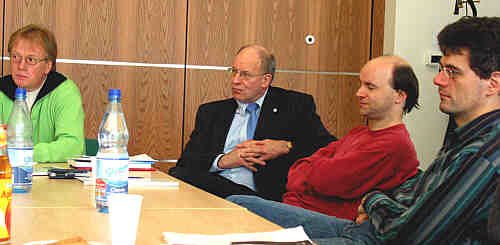
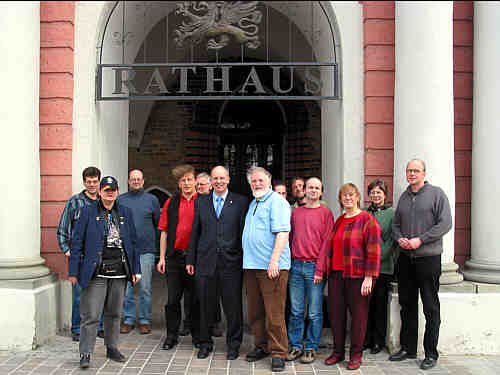
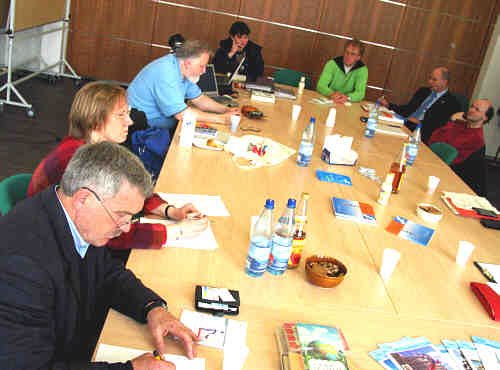
The German NGO Initiative Baltic Sea Cooperation, a loose coalition of German NGOs interested in the Baltic Sea Region, held a meeting on Saturday 8th of April in the Town Hall of Rostock.
The Initiative works as a link to the Baltic Sea NGO Network, which has organised the annual BALTIC SEA NGO FORUM since 2001. The Baltic Sea NGO Network since then was developed parallel to activities of the Council of Baltic Sea States (CBSS), which was founded in 1992.

Roland Methling, Mayor of Rostock Hanseatic Town, welcomed the NGOs in the Rostock Town Hall. Telling about some recent developments in Rostock and at the German Baltic Sea Coast, he expressed his readiness for closer cooperation also in frame of the NGO FORUM. As Rostock Town is f. ex. active in the Union of Baltic Cities (UBC), this could be also a link to the NGO-community.
Albert Caspari, the German Focal Point of the Baltic Sea NGO Network (co-ordinator of activities on German side), reported about two preparation meetings for BALTIC SEA NGO FORUM 2006 in Sweden (one held in January 2006 in Copenhagen, one in March/April 2006 in Stockholm).
The NGOs welcomed the proposals for four workshop-topics. Albert Caspari explained, that the Swedish organisers of the upcoming NGO FORUM will try to organise additional opportunities for meetings also for those initiatives, whose key aspects of activity probably will not be served by one of the main workshops.
The detailed programme for the BALTIC SEA NGO FORUM 2006 is still to be prepared by the Consultative Council (the Focal Points of every CBSS state - Norway, Finland, Sweden, Estonia, Latvia, Lithuania, Poland, Denmark, Germany). The NGO FORUM 2006 is going to take place in Stockholm at 5.-7th of October 2006.

The NGOs representatives at the Rostock meeting discussed some actual issues of the Baltic Sea Region, like HELCOM Baltic Sea Action Plan, problems of Atomic Power Use, sustainable use of energy, Oil Transport at Sea, and new NGO-laws in Russia and other Baltic Sea States. Several regional initiatives of Mecklenburg-Vorpommern presented their activities.

A lively discussion on opportunities of democratic participation in decision processes followed. Lutz Huettel and Dr. Burkhard Luber, two participants of the meeting, initiated the formulation of "NGO essentials" - a declaration of most essential rights, which all NGOs of the Baltic Sea Region should be granted in all CBSS-countries. The initiators hope that the text could function like a catalyst for a discussion among NGOs from different Baltic Sea States.

The participants of the NGO-meeting expressed their hope, that the work of the Baltic Sea NGO Networks German Focal Point would be possible to continue, even if no help in financing was available until now. The efforts for co-operation between German NGOs from different Northern German Federal States still has no partner on the Governmental bodies, as the German Federal States do not have a common concept for Baltic Sea Cooperation. The only partner for discussion and exchange of viewpoints until now is an advisor on Baltic Sea Cooperation at the German Federal Foreign Office in Berlin.

One project between NGOs in Germany and Poland was presented at a good example of positive results of the BALTIC SEA NGO FORUM in Gdynia / Poland in 2005.
Among the participants of the NGO FORUM 2005 were representatives of Fundacja Slonecznik Pomorskie (Gdansk) and Kulturzentrum Lagerhaus (Bremen). As a result of the NGO FORUM they agreed in starting a project, which aimed in bringing NGOs of both towns together, improving the contacts and starting new projects on various fields of activity.
The Bremen-Gdansk-project could be taken as a "good example" for NGO-cooperation (in contact to GOs), as this project was a direct result of BALTIC SEA NGO FORUM 2005.
More information is available (english!) at http://www.hb-gd-ngo-act.de/meeting.html)


Draft paper on "NGO ESSENTIALS" (to be discussed):
Essentials for Regulating the Activities of Non-Governmental Organizations with special reference to state authorities
  1. All NGOs´ acting falls under the specifications of the Universal Declaration of Human Rights, where especially articles 13 (freedom of movement and residence), 17 (right of property ownership), 19 (freedom of opinion and expression), 20 (right of association), 29+30 (exercising rights and freedoms) are relevant.
  2. NGO acting must be in conformity with international law regulations which basicly are used by the United Nations and national law regulations of the country in which the NGOs are acting, if it is not in conflict with international principles of human rights.
  3. The acting of NGOs should not be subjective to more restrictive regulations than those of the penal and civil laws of the country in which the NGO is acting.
  4. The legal regulations for starting and acting of NGOs should not be repressive, i.e. those regulations should kept on a minimum of procedures.
  5. Elements of a minimum transparency of NGOs should be: Presenting statutes, informing about changes in the NGO´s responsible board, transparency of finances.
  6. Conflicts between and NGOs and state authorities have to be submitted to and decided by independent courts with the possibility to appeal against court decisions on the base of the constitution and of the Declaration of Human Rights.
  7. NGOs, especially those of minorities, should be able to spread their information, news, and commitments by independent media in every language they like without discrimination by governmental authorities.

13. Januar 2006

Environmentalists discuss Gas-Pipeline

The Coalition Clean Baltic (CCB), a Baltic Sea wide network of environmental organisations, has raised its concern about the German-Russian Megaproject of a gas-pipeline crossing the Baltic Sea. "We all need open information sources, access to EIA materials, to be sure that all environmental impacts were considered thoroughly and sufficiently," says Olga Senova, CCB-member and eco-acticvist from Russia.
But many members of the network are not ready to express a final opinion, as many clear details of the planned project are currently lacking. "We should collect the information about possible environmental threats and what it could cost to the Baltic Sea," hopes Taavi Nuum from Estonian Green Movement. What he points to seems to be partly just a hope - as information about the plans of the Russian-German consortium are not available yet. "So far, we do not have sufficient and reliable information about expected environmental impacts, and cannot make valid conclusions," says Sergey Anatskiy (Baltic Federation of Fishermen) from Russia.

Business, just big politics, ignorance, or what?
But there are also other voices to be found. Some call the whole projekt "a business issue", other "very much a political issue". Voices are mixed, and concerns regarding a possible threat to the environment come together with disappointment, that Russia and Germany may try to keep the discussion as just an internal issue. "We expect that all the HELCOM member countries, especially those which also signed the Espoo Convention, like Germany, really start the cross-border EIA." Such statement voices Valdur Lahtvee, chairman of the Coalition Clean Baltic. (Source for all CCB-statements: CCB-Newsletter)

German eco's in silence
But where are the statements of the German environmentalists? Not much has been heard or seen up to now. Could it be the effect of the new "big coalition" of conservatives and socialdemocrates in Berlin, that irritate German ecologists? Quite many of the more experienced eco-functioneers had become used to have a "Green" partner also in the German government. Some environmentalists where offered well paid jobs in ministries and other institutions during the rule of the red-green's. Suddently the political szene has turned upside down. The former coalition-partner of the Greens suddently choose a new "best friend", who does not hide a strong willingness to reintroduce atomic power stations. And Joschka Fishers "best friend", the "dear Gerd", has made his personal deal with another "best friend" in Moskow, for assuring his personal earnings. Fisher himself has disappeared from the political szene. New green leaders currently look quite like the old ones, but even older. It does not seem to be popular any more to fight for the environment very much.
What may be the background of all this political games? Will the environment be the main looser?


The pipeline from Russia to Germany will have 1200 km of its route on the bottom of the Baltic Sea. Some already have made up their minds: "Well, apart from some limited areas of old stuff from last war it will be only mudd on the ground of the Baltic Sea." Who cares?

Different interests
Other opponents step into the arena. The 24th session of the presidium of the Baltic Assembly, where law-makers of Lithuania, Latvia, Estonia and Poland came together in Estonian capital Tallinn, passed a resolution concerning the construction of the North European Gas Pipeline (NEGP) urging Russia and Germany to consider ecological and economic interests of the four states. (as for ex. Russian paper Kommersant reports).
The resolution adopted in Estonia contains an appeal to the parliaments of the countries situated in the area of the Baltic Sea and the Council of Ministers of Baltic states to pay a special attention and look into the North European gas main project for its compliance with treaties on the protection of the Baltic Sea and laws of the European Union. The four undersigning states speak up clearly: The North European Gas Pipeline disregards interests of Baltic states as well as those of Poland.

But isn't it then again just a "business issue"? Do those, who protest against the project, just want to have a "piece of the cake"?
One other expert tries to calm emotions down. Andris Piebalgs, a Latvian, holds the post as EU-commissioner for energy. "I really have no doubts ... that the companies involved will do everything necessary for protection of the environment," he was quoted by
REUTERS.

But it seems interesting to follow what some
Russian press is expecting from the side of one of the smallest Baltic Sea States, Estonia. Three of the political fractions in Estonian parliament could initiatite a widening of Estonian sea borders to 12sm. If Finland would join the Estonian initiative - the gas-pipeline could be blocked. Once again, some question: Are governments of Estonia, Latvia and Lithuania (all three strong opponents of the German-Russian pipeline) got a "green heart", or is it just for trying to get a share of the business?
May be the year 2006 will show it soon.


EIA = Environmental Impact Assessment

Baltic Assembly = was set up in 1991 as a deliberative body on the cooperation between parliaments of Estonia, Latvia and Lithuania. It consists of 20 people from each of the countries.

23. Dezember 2005

New Russian Legislation on NGOs

This Post gives some links about the recent Duma decisions on the new Russian NGO law.

Peter Lavelle, an US think tank, comments on the 2nd reading on the law, referring especially on certain amendments in comparsion to initial bill version
http://www.untimely-thoughts.com/index.html?cat=3&type=3&art=2109

In another comment Lavelle observes the controversial debate on that law http://www.untimely-thoughts.com/index.html?art=2076

Bellona, a Norwegian environment foundation, also looks upon the 2nd reading on, with focus on foreign NGOs and the registration process for Russian NGOs http://www.bellona.no/en/international/russia/envirorights/info_access/41344.html

In another article Bellona stresses the so far mostly unnoticed point, that by the new law foreign and international organizations cannot longer operate in the so-called "closed cities" in Russia (which are a dark heritage of the former Soviet nuclear activities, mostly with high contaminations in their surroundings) http://www.bellona.no/en/international/russia/envirorights/info_access/41357.html

In his "Russia´s NGOs: It´s not so simple" in the IHT Nikolas Gvosdev looks on Russian NGOs with a considerably critical eye http://www.iht.com/articles/2005/12/08/opinion/edgvosdev.php

In an intense deeper going analysis Human Rights Watch critizices the law right from the legislative beginning http://hrw.org/backgrounder/eca/russia1105/

A profound legal analysis of the new law is done by EurActive, an independent media portal dedicated to EU affairs http://www.euractiv.com/Article?tcmuri=tcm:29-150717-16&type=News

The "International Center for Not-For-Profit Law" deals with the law on its initial draft status with links to the Russian and English texthttp://66.102.9.104/search?q=cache:zRP43Ky2ZbgJ:act4europe.horus.be/module/FileLib/ICNLanalysis.doc+analysis+of+the+draft+law+%22on+introducing+amendments&hl=de

Also from "International Center for Not-For-Profit Law" comes a lenghty analysis http://www.icnl.org/PRESS/Articles/2005/20051111.htm

2. Dezember 2005

How dangerous is it to live democracy in Belorussia?

Civil engagement in Belorussia - a nightmare?
Tatsiana Khoma, a 21 year old student at the Belarus State Economic University (BSEU), seems to have to pay a high price for being engaged just for students interests. In beginning of november 2005 she attended a conference of the "National Unions of Students in Europe" (ESIB), taking place in Reims, France. ESIB is an umbrella organisation of 44 national unions of students from 34 countries Tatsiana in Reims was among about 100 participants from all over Europe. - On November 24th the Universities administration informed her, that she will be expelled due to the fact that she attended ESIB's European Student Gathering "Higher Education and European Citizenship", without notifying the university. Tatsiana Khoma did not notify the university because of two important facts: firstly will the law on reporting your whereabouts to the university not take effect until two months, and secondly did she only visit the conference during the weekend.
All people under controll?
Belorussia is known as the country of one of Europe's last dictator, Aleksander Lukashenko, a man, who on his presidential website openly announces his motto: "I sometimes have to take unpopular decisions. I know that I will not be liked because of that." It seems, this kind of "top-to-bottom-education" is introduced in all the hierarchy of the country. At least Mr Vladimir Nikolaevich Shimov, Rector of the BSEU, seems trying to become a "small Lukashenko". Such methods seem to help a personal career - but not civil engagement for the interests of all people. Time by time some Belorussion organisations demand their participation also in the structures of NGO Baltic Sea cooperation. But sorry, ladies and gentlemen, please give us an explanation about such authoritarian behaviour - why it can happen, and why without your common and loud protest?

Students organisations are shocked
The European studentsorganisation ESIB strongly condemns the actions taken by the Belarus State Economic University, as an "unacceptable violation of student and human rights [with special reference to articles 19 and 20 of the Universal Declaration of Human rights]". ESIB has sent a letter to the Rector of the BSEU, for to demand stopping of the actions against Tatsiana Khoma, and to allow her to continue her studies at the BSEU without any further harassment from the management of the University.
But their is not much hope. The girl did not only to leave the University, but also her room at the dormitory.
The Norwegian Association of Students has started a campaign in favour of Tatsiana, and have already collected hundreds of signatures for three aims:
a) Tatsiana Khoma should be allowed to continue as an ordinary student at Belarus State Economic University (BSEU).
b) Tatsiana Khoma should be allowed to stay in her dormitory.
c)All students in Belarus should be able to engage in the student movement both nationally and internationally.
"It is completely unacceptable that a student representative is treated this way and we want to show that Norwegian students strongly dissapproves of these actions", says ?yvind Reidar Bakke, President of Studentenes Landsforbund (StL).

Any chance for a change?
Tatsiana's case now seems to becomes an object of diplomacy. Even ministries and rectors conferences row up for support. The Swedish Minister for Education also wrote a letter of protest. And there is - what a wonder - a reaction! In an open letter published at the Belarus State Economic University website, the rector declares that he will stand by his decision to expel Tatsiana Khoma. He says that Tatsiana "performed a rude violation of the inner regulations of the University and demonstrated her straight unrespect for BSEU as an organization which is legally and morally responsible for the students’ security during their educational process" and that the decision "was made in accordance with the norms of the Republic of Belarus legislation in the field of education". He also critizises the international organisations who have written to him so far.

ESIB chairperson Vanja Ivosevic says: "I think the main reason why no one asked the rectors' permission to send Taciana to France is the simple fact that this course of action is unheard of anywhere else in Europe! It is a human right to move and travel freely." ESIB is still appealing to governments and international organisations to ask the rector to reverse the decision of expulsion.

25. November 2005

Proposed law seen as threat to operation of NGOs in Russia

As finnish paper HELSINGIN SANOMAT reports, a new law in Russia could make the work of independent russian NGOs more difficult. Also AMNESTY INTERNATIONAL raises a voice of concern.

"Finnish and international civic organisations have expressed concern over their possibilities to continue operating in Russia in the future. The Russian Parliament is preparing to pass a law that would place tight restrictions on the activiteis of non-governmental organisations in the country. President Vladimir Putin expressed his support for the proposed bill in an interview on a newscast on the television channel Rossija on Thursday. He also promised to hold further discussions on the details of the bill with the senior members of the Duma.

The law, which would require all NGOs to register with the Ministry of Justice, could come into effect in 2007. The NGOs anticipate difficulties particularly for human rights and environmental activists, as well as for religious groups. However, the new law is not expected to cause many problems for social and health work, which the majority of Finnish organisations in Russia are involved in.

Nevertheless, Frank Johansson, executive director of the Finnish section of Amnesty International, sees the proposed law as very alarming. "This bill is likely to result in quite an extensive dampening of the operation of free civic organisations in various parts of the Russian Federation", notes Johansson. While Amnesty International in Finland does not expect the new law to have any effect on its own operation, it could substantially hamper the work of Amnesty’s press office in Russia. Furthermore, there is a risk that certain Russian cooperative organisations which are funded by various foundations could be closed down, argues Johansson. The Russian cooperative partners are the main concern of other civic organisations as well, even though nobody knows yet what the consequences of the proposed new law will eventually be.

"The Russian organisations have warned us that the new bill could lead to problems, hence hampering our cooperation", notes Merja Hannus, the Secretary General of the Finland-Russia Society. The society is carrying out tasks related to various issues including social equality, and training civic organisations in Russia. The Vaaka association is a Finnish voluntary group whose activities include collecting baby clothes to be delivered to Russian Karelia. "We have no Russian staff and no office in Russia, but we trust that we will be allowed to operate quite freely from Finland", says Tiina Seppälä of Vaaka. Project Manager Lea Ylitalo of Karjalan Apu ("Karelian Aid") believes that the forthcoming changes will not much apply to the Russian operations of social and health groups.Arja Käyhty of the Dikoni project agrees. "Our work has met a very positive response in Russia, for we have not expressed any criticism that would undermine the foundations of Russian society", Käyhty concludes."

"Russian Federation: Draft law -- the latest in clampdown on civil society", writes AMNESTY INTERNATIONAL on the same issue. "By allowing government officials to deny registration to NGO's according to such vague criteria, there is a grave risk that decisions on which organisations are allowed or banned will be politically motivated," said Nicola Duckworth.

Baltic Sea Foundation for Environmental and Regional Development + Support Circle "Livonian Common Weal and Economic Society" of 1792

The (in English) "Baltic Sea Foundation for Environmental and Regional Development", (in brief: "Baltic Sea Foundation") is an Estonian civic law (registered name: Läänemeere Keskkonna- ja Regionaalarenduse Sihtasutus) body corporate which will shortly be inserted in the Estonian official register of private non-profit organizations (NGOs).

The seven Founders hold, either Estonian, or Swedish or German nationalities. They have different professional and social back-grounds. But, since years, they practice exceptionally good neighbourhood relations in Western Estonia (peninsula of Noarootsi / Nuckö, close to the spa of Haapsalu / Hapsal).

They found together under the roof of the Foundation to demonstrate their firm willingness to undertake joint activities for the benefit of civic society and common interest, not only in Estonia, but Baltic Sea region wide.

Continued below....

ooo

The "Support Circle 'Livonian Common Weal and Economic Society' of 1792" (in brief: Livonian Common Weal) is the German counterpart of the "Baltic Sea Foundation".

The Support Centre, for the time being, is an informal body. But it is intended to transform it, as soon as possible, into a civic association or - even better - into a foundation, incorporated under German civic law.

The denomination "Livonian Common Weal", at one hand, draws the attention on an example of singular dedication which is fully in-line with the aims and objectives of the "Baltic Sea Foundation"; at the other hand, it intends to bring the successor countries of Livonia - Estonia and Latvia - closer to each other via general interest non-profit co-operation.

Cosmopolitanism was a characteristic of the old noble "Livonian Common Weal and Economic Society"; its heritage is honoured by practising this attitude.

Continued below....

ooo


Baltic Sea Foundation

Background

The Foundation approaches its action fields of “Development of Environmental Protection” and “Regional Development” in a complex way, i.e., always having in mind the civic society and social contexts because only a broad view can produce long lasting effects.

This methodology requires close and permanent exchange with the people, taking into account their backgrounds and, additionally, confidential relations with the official authorities and with other common interest institutions, in the country and abroad, as well.

The Founders are convinced that progress is driven, above all, by the engagement of the inhabitants themselves, especially those of the new EU countries, in the shaping of their habitat and its future. They aim at reaching sustainable solutions through general interest activities, with the help of the Foundation or its allies.

The principal promoter of the Foundation and its actual Chairman of the Supervisory Board is Juergen Lewerenz (tel. + fax in Germany – October to May: +49.2642.1532 and in Estonia – June to September: +372.47.41193. Permanent postal address: Am Bach 12, D 53424 Remagen, Germany; additionally, in Estonia during his above mentioned stay there: Mikutalu, EE 91201 Pürksi, Noarootsi; e-mail: lewerenz.juergen@freenet.de).

Over decades, Jürgen Lewerenz has accumulated experience with developing and reform countries (MEE) and with the subject related national and international, private, as well as official, institutions. Only during half of his professional career he fulfilled desk-duties at administration head-quarters. During the other half, he worked in Latin America, in Bangladesh and within and for all three Baltic countries[1]. He also served the EU Commission PHARE and TACIS Programmes.

The remaining Founders live at Noarootsi in Western Estonia, or close to the place. They are: Birgit Eldh from Spithami / Spithamn, Nova commune, with an additional residence on the island of Gotland; the couple Elar and Leili Piir, both from Noarootsi, Valeri Đeripov and Alar Uus, also from Noarotsi, and Liivia Leškin from Haapsalu.

The Foundation has been able to win a General Secretary. He is the new pastor at Noarootsi parish who, besides from his half-time parsonage attends – heroically – the inmates of the not far away Estonian central jail.

It can be anticipated that the Foundation has to contract paid personnel, in a not too far away future. Because of the absence of sufficient revenues from invested financial resources of the Foundation, personnel costs and other expenses will have to be covered from project budgets.

The task ahead is immense and long lasting. Under the given circumstances, collaborators are needed who volunteer, assuming charges and sacrifice.

State programmes will be utilised but subsidies must and will only be complementary resources; they will be employed to reach targets quicker. They must never be a substitute for own efforts and responsibility.

The Estonian Ministries for Environment and for Regional Development (in Estonia, under the roof of the Home Ministry) and the – vast by its space but small by the number of inhabitants – municipality of Noarootsi have contributed valuable advice during the stage of designing the Foundation because the public authorities of the country require reliable, safe, autonomous, civic society based, democratically operating common interest minded executing bodies with whom they can work together for the success of reconstruction and development programmes.

Ahead of giving the Foundation its actual shape, it has been discussed to develop, out of the Noarootsi based local, half-official nature and environment institution (SILMA), a communal foundation with a wider objective, i.e. including “regional development”.

Finally, this transformation could not be reached because of the decision of the Estonian State to re-organise the public nature and environment protection and to separate it from the local authorities; this field will become directly State governed[2], at the end of the current year.

By defining the whole of the Baltic Sea basin as its sphere of activities, the Founders have freed themselves from local narrowness and from too strong influence by communal policy, without giving up the friendly relations with their home municipality and their place of origin.

The Foundation has been registered, only a few weeks after its notarial enactment and, thus, it is now a body incorporate.

Within short, it will be entered in the National Register for Common Interest NGOs (“NGO Register”). This is the entrance door for bidding for the execution of official projects from nature and environment or regional development programmes, or for requesting official support for projects under its own responsibility.

The Foundation will co-operate closely with like-minded national and expatriate personalities and with analogous bodies, especially with such from EU countries.

Consortial relations (with Germany and Sweden) have commenced, long before the Foundation has been enacted.

The communication, within the Foundation and with the external world, inside and outside Estonia, will be preferentially in English.


Projects

The first projects of the Foundation will be closely related to its region of origin. These are, for the moment:


(English language commented) fotos show– to be presented in the Baltic States and in other Eastern or Western countries, as well – on the theme “Nature and Environment (possible sub-theme: ‘Birds’) in Western Estonia and a (to be defined) German reference region”, with special attention to the rich but, nevertheless, also in Estonia endangered natural circles, comparing the Estonian situation with the damage done in the respective German region. Harmful human influence; lessons learnt from mistakes; decided upon consequences and such still in discussion; protective and nature repair measures – all will be shown and described.

Co-operating (preferably: boarding) schools in Estonia (candidate: “Noarootsi Gümnasium” at Pürksi, Noarootsi municipality – due to its close relations with the here traditionally settling ethnic Swedes, usually called the “Swedish Secondary School”) and in Germany (suitable candidates are envisaged but because of un-concluded discussions, it would be premature to name them here) shall participate actively in the preparation of the event, from the start on.

The co-operating schools shall host the presentation. Boarding houses – where they exist - shall be used and, additionally, other suitable places in the neighbourhood of the schools (in Noarootsi: Lyckholm / Saare Manor, which focuses birds protection, and the close-by Lyckholm Museum).

The schools co-operation shall go hand-in-hand with a partnership between their home municipalities. This could partnership could be supported under the EU Commission “Town Twinning Programme”.

To this end, measurable own efforts have to be contributed which, in this case, could be produced (certainly mostly in kind), without major difficulties, or by the students, or their teachers, or the parents, or the municipalities, or other helpers.

On the German side, an experienced nature protection institution of a “Land” has committed itself to donate exposition material, out of its own stock or to procure it from its partners, and to help with specific know-how.

The event shall take place during the summer 2006 vacation period when the facilities of the schools and the boarding houses are available.

The preparatory period is short but sufficient – if all involved get started soon. (If not, the project will have to be postponed.)

Subsequently, the exposition shall “migrate”, not only in the Baltic Sea region but also in the West and beyond the Baltic Sea countries.

It would be desirable to develop, out of this first co-operation, a durable cohesion between the schools, their students, the parents and the teachers.

o


Professional movie on bird’s life in Western Estonia – one of the most important European migrating birds’ spots – for TV. This project idea originates from the local Noarootsi nature and environment body, SILMA (about SILMA, see above). Actually, with the assistance of like-minded institutions abroad, producers and connections with media institutions are sought. Interested individuals and institutions are welcome.

o


Local (= Western Estonia) conditions adjustment of techniques for the use of alternative energy resources – envisaged focus: geo-thermal heating -, with the help of qualified professionals, producers and independent institutes. Success promising contacts are under way.

o

Because of the close relation to the operational field “Regional Development”, the Foundation will also act for the rescue and restoration of monuments (and, within this context, for the re-activation of examplary, still to-day valuable, traditions). The project sketched below is actually discussed:

Restoration, in-line with valid rules and regulations for national monuments, of the roof of Riguldi (Swedish: Rickul; German: Rickholtz) Manor in Noarootsi municipality which is covered with - now widely damaged - Rhenanian slate (the manor buiding is actually owned by the City of Tallinn where it runs a summer school for mentally handicaped children), plus the transportation of the slate material - from the (usual) river Rhine shipping port of Andernach (Germany), via the North Sea and the North Sea – Baltic Sea Canal (or through the “Skager Rak” and the “Kattegatt”) and the Baltic Sea - to a port close to the Manor site, with a traditional sailing cargo-boat, formerly owned by Swedish Estonians and now completely re-habilitated by their grand-children and helpers.

o

Financing of services (such as: purchase commissions; health care; official administration and public services matters) for aged, remote living “singles” with poor income (test region: Noarootsi), out of the sale of attractively packed high quality products, on the basis of raw materials coming from home gardens, from forest and fields and processed by the aged themselves, including a mailing service, on “peasant’s markets”, at touristic crossings, during summer time.

o

Development of western (medical and catering) standard health centres (focus: re-habilitation medicine and nursing of handicaped persons), in the neighbourhood of the famous and attractive spa of Haapsalu / Hapsal (tradition: curative mud baths; see –for the history of the spa: http://www.framare.ee/) for Western European patients (model: Haapsalu’s success with social welfare and private Finnish client?le), in partnership with innovative, cost effectiveness and internationally minded Western institutions (rehabilitation and nursing centres, especially their training and logistics branches; insurers; concerned official bodies) – as alternative for hiring personnel from this region for Western service institutions.

In spite of the relatively low salaries in Estonia, returners would be enabled to increase their savings capacity because of the considerably lower local cost of living, compared with the Western high-cost host countries. They would be in a position of benefiting from Western type professional up-grading without being deprived of their personal, institutional and material connexions.

o

Generation of a system of thorough and in-depth audit of common interest or needy target groups oriented institutions which use “other persons’ money”, i.e. public subsidies and/or private donations, coming from internal sources or from abroad or who handle people’s savings.

The proposed system would enhance the much needed trust of supporters and costumers of such institutions and, at the same time, it would help to cleansen the NGO and the self-help world from abuse and incompetence.

This type of audit would be much more intense and far reaching than ordinary commercial audit or State Supervision ever could be. Also the conduct and the performance of leaders and managers would be judged.

The official control organs would be backed by the new system. They could rely on it what would not only ease their work burden; it would fortify the autonomy, the acceptance, the spread and the effectiveness of the audited institutions, for the benefit of the national community, as a whole.

Possible extra costs – compared with conventional controls – would be, by far, exceeded by a safety and acceptance surplus. The audited institutions would not be oppressed; on the contrary, their chances to survive and to grow would increase.

Under such a control regime, community supporting institutions, most probably, would pop up in big numbers, non-profit NGOs and commercial enterprises of this type, as the so-called self-help businesses, i.e. co-operatives, mutual societies or communal businesses, as well.

The failure of the numerous, often very expensive, attempts to re-activate people’s banks, mutual insurance societies and other financial institutions, serving low and middle income groups in the “transition economy” countries, was mainly caused by the absence of safety, caused by unsatisfactory control mechanisms. Therefore, the emerging self-help enterprises did not convince the authorities and the public did not trust them either.

The best way to develop the suggested system quickly would be the voluntary submission of the addressees to it. The proposed mechanism could be managed by associations of which the audited are members; the main role of the State Supervision bodies would be to keep a vigilant eye on the performance of the self-control system, instead of controlling individual “grass-root” institutions.

The best suited and most reliable model would be the so-called association audit, practiced, since long ago and successfully, by co-operatives and savings banks in Germany and in other countries of Continental Europe.

The positive social impacts and the competitivity, for which the financial institutions of these groupings are known, are, above all, based on their effective self-audit mechanisms, a fact which merits to be highlighted.

It would be in vain to request direct involvement of the mentioned groupings but access to their special know-how could be opened via technology facilitation agreements.

For the Eastern Baltic Sea Region inhabitants, the proposed modality is not absolutely new because, until World War II, there were successfully operating cooperative banks, mutual savings, loans and insurance societies, as well as muncipality banks in almost every place which – of course – practised self-audit, in a similar way as described above.

A valuable heritage of business culture of the Baltic Sea Region would be re-born with the application of this control mechanism.

Possible partners for the promotion, the preparation and the introduction of the new modality could be forward looking business auditors in the Eastern Baltic Sea Region and, additionally, the responsible State Supervision authorities and – of course –accountability minded leaders and managers of non-profit and commercial NGOs (the “Baltic Sea Foundation” included).

Co-operating partners could be Western auditors who intend to create a rewarding new field of attractive and competitive activities, beyond their usually practiced range of activities.

o

Complementary contributions and co-operation

The fortune of the Foundation – the main pillar of each institution of this type – is still rather modest because free resources are scarce among the Co-Founders.

Each of them contributed – apart from paying the erection expenses – according to the individual possibilities. The most urgent need was to reach the minimal amount required for the official registration.

It can be foreseen that no major additional endowments will come from the Co-Founders group. Each of the Founders possesses some property but this is entirely required for the subsistence of the family and as protection against risks of life.

Therefore, the Foundation is looking for complementary contributors. Money donations are especially welcome but also real estate may be donated, for instance restituted property in the Baltic countries which is not exploited by the title holders themselves.

Donations may be addressed directly to the “Baltic Sea Foundation” or – which will perhaps be preferred by those living (and paying taxes) in Germany and by citizens of other Western countries, to its German counterpart, the “Livonian Common Weal” (see below).

The Foundation’s intention is to co-operate with like-minded persons and institutions, especially for bidding consortia for the execution of official and private projects and for self-governed undertakings, with or without external support.

Since the Foundation is actually still unable to contract paid personnel und because the Founders have little free time, the call for volunteering collaborators is repeated, at this stage.

ooo


Livonian Common Weal (Society)

The “Support Center ‘Livonian Common Weal and Economic Society’ of 1792 is the Germany based counterpart of the “Baltic Sea Foundation”.

In addition to its support function, the “Livonian Common Weal” may operate in other fields which are compatible with the objectives of the “Baltic Sea Foundation” and the good traditions of its historic patron.

The “Livonian Common Weal”, for the time being, is handled by Juergen Lewerenz alone.

The Support Circle has been startet informally but it shall be transformed – hopefully soon – when additional persons or institutions join and more material and personal resources find together under its roof, into a registered civic society or, even better, into a German civic law foundation.

German income tax deduction possibilities (EStG – Einkommensteuergesetz - and AO - Abgabenordnung) played an important role when conceiving and locating the Circle.

The title “Livonian Common Weal and Economic Society” (its German name: Livländische Gemeinnützige und Ökonomische Societät), founded in 1792 in Riga, was incorporated because it is an intentions close example for the new “Baltic Sea Foundation”.

The Society is an out-standing intellectual monument and a tradition of good practice which merits to be honoured; it is worth-while to re-habilitate it.

The “old” Livonian Common Weal Society, for a century and a half, has been a positive expression of Baltic Sea culture which, since centuries, had many ties with the West, not only with the German speaking world.

The (old) “Livonian Common Weal Society” operated, for the benefit of its home region, until the beginning of World War II.

It held very closely ties with fellow institutions in the neighbouring regions of Livonia, the “Courland Economic Society” of 1836 (in German: Kurlaendische Oekonomische Gesellschaft) and the “Estonian Agricultural Association” of 1839 (in German: Estlaendischer Landwirtschaftlicher Verein).

In 1813, the “Livonian Common Weal” was transferred to Tartu (Dorpat). This domicile was kept until the end of its activities (in 1939).

In the middle of the 19th century the Society was re-named into “Imperial Livonian Common Weal….” to stress its close relations with the Zaristic crown. This name was kept until the separation of the “Baltic Provinces” from Russia, at the end of World War I.

The split of the Livonian territory and the annexion of parts of it to the, at that time, newly created, countries of Estonia or Latvia, respectively, made the undertakings of the “Livonian Common Weal” somewhat more difficult. Its co-operation with Latvia weakened a bit but, nevetheless, it kept its original orientation towards the whole region and its progress.

The activities ended with the destruction of civic culture in the Baltic Region and the isolation imposed by the occupants.

The reconstruction efforts can become effective if the initiator is not left alone. At the end of the presentation he re-iterates his wish to win personal and material support.
[1] Juergen Lewerenz was – in the period 1992-1993 - the first long-term EU adviser for Estonia (Bank of Estonia – Eesti Pank). Apart from his official job, he volunteered, upon request of the President of the Central Bank - anonymously and without honorary or consent of the EU Commission, for the design and the introduction of the new Estonian currency. All this took place, ahead of the return of the country to the international central and commercial banking community. His experience during these harsh and conflictive times was laid down in his (German language) book, titled “Banken im Baltikum. Gestern. Heute. Morgen?” (Banks in the Baltic. Yesterday. To-day. Tomorrow?) Fritz Knapp-Verlag. Frankfurt/M.. 1997. Germany. ISBN 3-7819-0590-X
[2] Noarootsi will be incorporated into one of eight Nature and Environment Districts, each of them with a Regional Office. The Regional Office for Noarootsi will be 50 km away. To maintain, nevertheless, the local ties, it is envisaged to keep a local Liaison Centre at Noarootsi. Projects will no longer be executed directly by the authority but delegated to suitable NGOs, such as the Foundation. It may well be that also such undertakings which started, ahead of the reform, and which are already financed out of State ressources, will be included in this transfer. The foundation would like to apply for such projects, or as commissioned body, or for their execution under its own responsibilty.

3. November 2005

Meeting of German NGO-Initiative for Baltic Sea Cooperation in Hamburg, 29.10.2005

Fruitful meeting
On Saturday, 29th of october, the German NGO-Initiative for Baltic Sea Cooperation came together for an annual meeting. 14 participants met in the house of the Lawaetz-Foundation, Hamburg.

Our meeting was attended by 14 people, including Mr Jan-Axel Voss, advisor on Baltic Sea Cooperation at Federal Foreign Office, Berlin.
(contact: Jan-Axel Voss, Auswärtiges Amt, Ref. E 07-9, Berlin,
e07-9[ät]diplo.de)

The participants:
Albert Caspari, Verein INFOBALT, Bremen,
post[ät]infobalt.de
Stefan Hansen, Hohe Tied e.V., Kiel, greenbalt[ät]aol.com
Lutz Hüttel, FIDEA e.V., Hamburg, webmaster[ät]fidea.de
Burkhard Luber, Stiftung DIE SCHWELLE, Bremen,
luber[ät]dieschwelle.de
Gerhard Maschack, Kulturzentrum Lagerhaus, Bremen, gmaschack[ät]web.de
Frauke Rubart, Kulturzentrum Lagerhaus, Bremen, fraukerubart[ät]aol.com
Bernd Scheda, Kulturzentrum Lagerhaus, Bremen, info[ät]kulturzentrum-lagerhaus.de
Maik Schulz, Verein BaltiCult, Neustadt-Glewe/Ortsteil Tuckhude, maik.schulz-2.vorsitzender[ät]balticult.de
Karin Schmalriede, Lawaetz-Stiftung, Hamburg, schmalriede[ät]lawaetz.de
Alicja Skodowska, Deutsch-polnische Gesellschaft, Hamburg, alchemikde[ät]yahoo.de
Hans-Joachim Tiefensee, Verein INFOBALT, Bremen, joachim[ät]infobalt.de
Christian Wellmann, Schleswig-Holstein Institute for Peace Research (SHIP/ Kiel), wellmann[ät]schiff.uni-kiel.de
Hartwig Zillmer, Deutsch-Polnische Gesellschaft, Hamburg, ha.zillmer[ät]web.de

In the first part of the meeting we gave some time to everybody to introduce each NGOs work and projects. Participants came together from four different Federal States: Schleswig-Holstein, Hamburg, Mecklenburg-Vorpommern and Bremen.

Later we continued our meeting with a short review on the BALTIC SEA NGO FORUM in Gdynia/Poland. All participants of NGO FORUM 2005 regarded the Forum as very useful for better cooperation with especially polish NGOs, as it was a good chance for meeting and discussions. Some new projects were born at the NGO FORUM, and part of them even realised already in 2005. Especially positive reports came from Kulturzentrum Lagerhaus, Lawaetz-Stiftung, INFOBALT and from FIDEA. Many German participants felt the FORUM as being one day too short - not much time to really get to know people and finish discussions. Other remarks were, that it was, as always, important to get a picture also of the meeting place outside the conference-halls (to get an impression of the atmosphere at the spot). Some people expressed their wish to have a place for introducing their projects at future NGO FORA, others wished to have more young people involved into Baltic Sea NGO Networks activities.

Mr Voss told about his experiences in his new job as advisor for Baltic Sea Cooperation at the German Foreign Office. It was an open and friendly discussion of different views and experiences. Mr Voss told about some topics raised by the Islandic presidency during recent meetings of CBSS-officials: measures against traficking, for energy-networking, Baltic Sea as PSSA - particular sensitiv area, Baltic Sea wide radiation-measuring, and the willingness of CBSS for more cooperation with Ukraine.
During the discussion a question came up on experiences of "NGO-support-offices" in East-European countries. As German NGOs don't have such offices, they are not able to hold a constant contact and propose more cooperation. Many of German NGOs believe that they do not know much about the situation of NGOs in other countries and lack a constant contact to "NGO think tanks" in Baltic Sea countries. The communication inside the Baltic Sea NGO Network seems to be too sporadic and changeful for getting a constant input on the situation in CBSS-countries, but of course we hope for improvement in future.

Some decisions of our meeting:

1) As the update of our webpage www.cbss-ngo.de would cost too much money (which we don't know where to get from), we open another common (english language) webpage, which es easier to handle, and cheaper.
The adress is
www.baltic-ngo.blogspot.com , and contributors of Baltic Sea NGO Network are also invited to participate.

2) We continue to inform all members of German NGO Initiative for Baltic Sea Cooperation by an Email-Newsletter. It is open to every NGO interested. Contact: post
[ät]cbss-ngo.de

3) We continue to hold annual meetings of our NGO Initiative. We will try to change meeting places, for holding travel costs acceptable for all participants. After having had meetings in Kiel, Berlin and Hamburg the next annual meeting in 2006 will be held in Rostock. We will decide about the date after getting to know the date for BALTIC SEA NGO FORUM 2006 in Sweden.

4) We discussed possible speakers for thematic networks of the Baltic Sea NGO Network.

Environment - Annelie Ehlers (CCB-network) or Stefan Hansen (Hohe Tied) greenbalt[ät]aol.com - further information can be asked from Stefan Hansen

Culture - Lutz Hüttel, FIDEA.
webmaster[ät]fidea.de Lutz will write a paper on his interpreation of the activities on this field.

Human Rights - Burkhard Luber
luber[ät]dieschwelle.de. Burkhard already wrote a paper on the issue and put it on our new Website www.baltic-ngo.blogspot.com

Social affairs - Karin Schmalriede (
schmalriede[ät]@lawaetz.de). Karin regards the field of all possible social activities as too broad and general, and will write an own paper on what she can do.

Voluntary work - Stephan Malerius, "German-Russian Exchange", Berlin,
stephan.malerius[ät]gmx.net . Stefan is ready to tell about many experiences with voluntary projects of "German-Russian Exchange", also in Ukraine.

Civil security - no one of us acitive on this field.

Regional development (possibly together with culture, Lutz Huettel will write a paper on the topic)

5) We decided on a new version of common paper on the aims of our German NGO-initiative. The German version of this new paper (which will renew the "Berlin declaration" of 2001) will be possible to access at our common webpages soon.

6) We will collect proposals from different NGOs regarding the 1.preparatory meeting for BALTIC SEA NGO FORUM 2006, which is planned to be arranged in Copenhagen 27.-29.1.2006.
Some first proposals are: Fishery, discussion between social NGOs/Trade Unions/fishery associations/environmental NGOs, traffic in the Baltic Sea region, alternative journalism, NGO capacity building, conversion.

7) We discussed possibilities to have an "Baltic Sea Office" for the German NGOs. Since we did not see realistic sources for financing, this option seems to be still an illusion. But on the other hand activities of the German NGO-initiative for Baltic Sea Cooperation can not be arranged only on voluntary base (as from 2001 until now). The government of Hamburg offered support and consulting for EU-programmes, but condition is that it should fit into the interests of Hamburg town (as we do not concentrate on one Federal State only, this condition is difficult). In Bremen the "Culture Center Lagerhaus" offers rooms for such Baltic Office, but still some money is needed to cover the costs. We will continue in evaluating the possibilities.


Albert Caspari
INFOBALT e.V.
www.infobalt.de / post[ät]infobalt.de
NGO Initiative Ostseekooperation www.cbss-ngo.de

1. November 2005

Human Rights, NGOs and the Baltic Sea Region

On a meeting of the German Baltic Sea NGO Initiative at Oct 29, 2005 in Hamburg I have been asked to act as the German contact person for the NGO Baltic Sea Network on the issue of Human Rights. The subsequent paper lists some aspects of the Human Rights topic and deals with the question how NGOs generally and NGOs in the Baltic Sea countries specifically can promote that topic. Comments are welcome!

Contact: hubluber@web.de * Work: http://www.dieschwelle.de/ *
Blog: http://www.nienburg44.blogspot.com/

Dr Burkhard Luber
The Human Rights, Non-Governmental Organizations
and the Baltic Sea Region

- An initial navigation of uncharted waters -


Making the Human Rights universally was an act of the Western Allies against German Fascism in the mid of the 20th century. That it has been a Western concept is symbolized in choosing New York as the United Nations headquarter. Launching the Declaration of Human Rights demonstrated what the WW II winners thought to become world-wide standard. For more than five decades this concept did not face major problems (Cynics might say: It had not much genuine impact on the international community either). References to Human Rights worked well for inauguration speeches, sometimes it was a tool of reciprocal reproaches in the East-West Conflict. But it never underwent the major test, whether the UN countries would take the concept earnest and work with emphasis against countries violating Human Rights on a major scale.

Three events at the end of the last and the beginning of the current millennium changed this situation:

First:
The disintegration of Yugoslavia with its broad-scale violating of human rights showed the sensitivity of the Human Rights concept and its application in conflicts of multi-ethnic countries.

Second:
The development of religions in the world has two contrasting spiritual tendencies. On the one hand you see an impressive secularization. Religion becomes less and less a decisive reference point for the population. It is merely an individual attitude not having a societal impact. On the other hand we see the renaissance of religious intolerance and fanatism.

Third:
The 911 terrorist attacks in the USA changed the dealing with the HR concept in three ways:

First it marked the long lasting universalism of the Human Rights concept. More and more people and countries are challenging this Human Rights uni­ver­salism by ranking religious values higher than observing Human Rights standards. That has even lead to an increasing disqualification of the Human Rights concept as a “Western imported product” to dominate the world. For an increasing number of countries the universalism of Human Rights is no longer valid, though so far none of those countries has acquitted its UN membership.

But 911 has also another 2nd consequence for the weakening of the universal Human Rights concept: Since the Bush administration narrowed its policy guidelines to concentrate more or less totally towards the war against terrorism, the universal observance of Human Rights became obsolete. Bush became more and more insensitive towards the Human Rights account of the allies he chose in his anti-terrorism strategy. That is at least evident for such authoritarian regimes like Turkme­nistan, Uzbekistan, Pakistan and Saudi Arabia.

Third consequence: Countries beside the USA took Bush´s anti-terrorism strategy as a welcome chance to claim membership in this anti-terrorist alliance. That gave them the chance to declare as "terrorists" also in-house freedom-fighters, seeking secession minorities and other counter-government actors on their own territory. Prominent example is Russia´s stance against Chenya and other independence movements in the Caucasus, but other governments in Africa and Asia are taking that chance of political rhetoric too and more might take it in future. So Bush´s crusade against terrorism generates a severe decrease of relevance for the Human Right concept.

The Relevance of the Human Rights concept for NGOs
NGOs are natural partners of the Human Rights concept, since their specific contributions to a civil society - like: gender issues, lobbying for minorities and free media - can mostly take their justifications from the “Declaration of Human Rights”. NGOs can be watch dogs, which monitor the Human Rights account of their own government and society and - based on the universalism of the Human Rights concept - also internationally. NGOs are also suitable Human Rights monitors, since they are closer to the societal reality and the needs and wishes of the population than higher ranking administration and governments. And due to their small organization profile and well elaborated information exchange and brainstorming capacities, NGOs can better formulate designs for addressing and solving single Human Rights deficiencies than large government ministries and agencies.

When addressing the question whether there are there specifics for the Human Rights work for NGOs in the Baltic sea region one has to make a short political assessment of that region. Its political changes since the end of the Cold War are significant: Beside Sweden, Finland and Russia all the Baltic Sea region countries are now NATO members and beside Norway and Russia all are EU members too. However simultaneously to the membership expansion of NATO and EU in the Baltic Sea Region the relevance of both these GOs has dramatically decreased. NATO (at least as an independent military factor of itself, i.e. more than a mere logistic contributor to the US worldwide military strategy) does not play an important role in all curren$t major military events (Wars on the Balkan, Iraq War, War against terrorism). NATO´s irrelevance is matched by an EU being in a major crisis due to growingly irritations from the consequences of its recent expansion, its failed constitution ratification process and the looming danger of not having a properly approved budget in 2007. This is the broader international political context in which NGOs in the Baltic Sea Region are acting and the question is whether specific fields of NGOs work in that region can be defined. Here are some proposals:

Minority issues
which are relevant for the Russian minority in Estonia and Latvia. Here NGOs can contribute to stabilize a fair and just minority regime which can also have relevance to other European regions of multi-ethnicity (like SO-Europe and the Roma in Central Europe).

Work Employment Issues
which are relevant for all Baltic Sea countries be they tigers (Estonia) or trailers (Germany). Based on Article 23 of the Declaration of Human Rights, NGOs can contribute with proposals how to implement the Human Right for employment in economies, in which profit increase and work force decrease are complementary to each other. NGOs should publicly brainstorm the issue of unemployment much more ambitious than their governments do it, since governments for decades are unsuccessfully waiting for more economic growth with the vague hope that this would generate new jobs. Employment concepts drafted by NGOs could contrast that blind road thinking of governments by emphasizing that unemployment is no longer a temporary event but is the structural consequence of growing digitalisation and miniaturization of more and more economic processes which demands less and less human work force. NGOs can contribute to the current debate about the future of global economy and work force by shifting the focus of this debate from helpless seeking for government assistance programs. NGOs can emphasize that large areas of the economy do not need full employment of the available working force, which means that the employment issue is no longer a technical task, but has become an issue of justice and just distribution of the continuously decreasing number of necessary work forces in the production field.

Human Rights Issues which have a latent relevance
for all societies in the Baltic sea region like: Gender equality, protection of children, decreasing of violence in the mass media and the entertainment industry, right for conscientious objection against military service, protection against unjustified surveillance of the state against its citizen, freedom of mass media.

If NGOs in the Baltic Sea Region will deal with such Human Rights issues above, they will have sustainable relevance for this region as constructive and critical partners of governments and other major players in that area. Thus they can play an important role for the civic societies in their countries and the Baltic Sea Region.

To fulfil their monitoring roles adequately, NGOs should especially use all relevant electronic information and online publication tools (like emailing lists, blogging, podcasting etc), since their ease of use, low price level and quick public impact makes them highly appropriate tools for the NGO community, thus favoring their aims and work more than the traditional tools of NGO-commitments. Thereby NGO have the chance to act towards governments and big players in the society and internationally on an equal level of competence and efficiency.